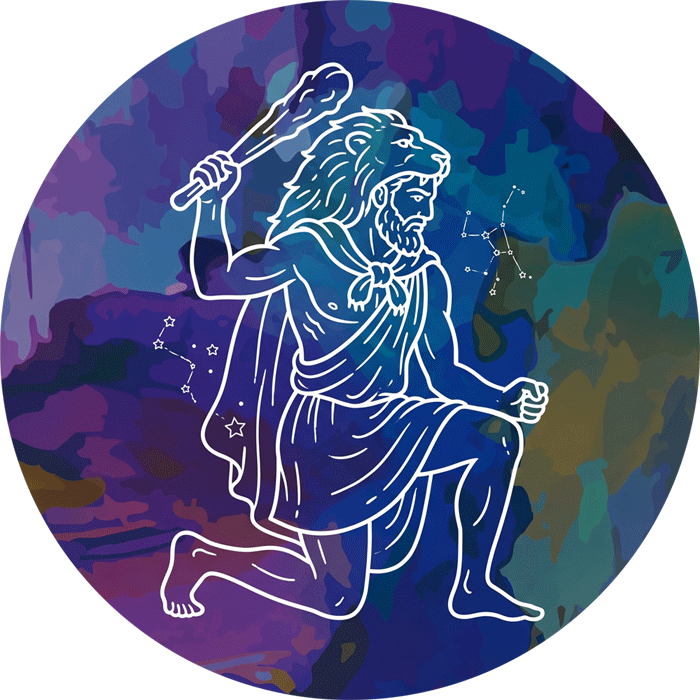
Hercules Constellation
The Kneeling Hero · Abbr. Her · RA 15h 51m – 18h 55m · Dec +51.3° to +4.0° · Hercules family
Hercules commemorates the greatest hero of Greek mythology, depicted kneeling among the stars, often shown with one foot planted on the head of the dragon Draco nearby. Despite being the fifth-largest constellation in the entire sky, Hercules contains no star brighter than magnitude 2.5, making it surprisingly easy to overlook — but tucked within its Keystone asterism lies one of the finest deep-sky sights in the northern sky, the Great Globular Cluster, a swarm of several hundred thousand ancient stars bound together by gravity.
Hercules at a Glance
- AbbreviationHer
- Genitive FormHerculis
- MeaningThe Kneeling Hero
- Constellation FamilyHercules family
- Area1,225 sq. degrees (5th largest of 88)
- Right Ascension15h 51m – 18h 55m
- Declination+51.3° to +4.0°
- Brightest StarKornephoros (magnitude 2.77)
- Best Evening ViewingJuly, visible 90°N to 50°S
Mythology and History
Hercules, the Roman name for the Greek hero Heracles, was the son of Zeus and the mortal woman Alcmene, and famously completed his Twelve Labors as penance after being driven briefly insane by Hera, who resented him as living proof of her husband's infidelity. His feats included slaying the Nemean Lion (commemorated in the constellation Leo), battling the multi-headed Hydra, and capturing the guardian of the underworld, Cerberus. In the sky, Hercules is traditionally shown kneeling, one foot resting near the head of the dragon Draco, in a pose some ancient astronomers linked to his battle against Ladon, the serpent guarding the golden apples of the Hesperides. Hercules was one of the 48 constellations recorded by Ptolemy in the 2nd century AD.
Notable Stars in Hercules
Kornephoros, Hercules's brightest star at magnitude 2.77, is an orange giant roughly 148 light-years from Earth — notably faint for a constellation of such enormous size, since Hercules is the largest of the 50 constellations with no star brighter than magnitude 2.5. Rasalgethi, marking the hero's head, is a massive, slowly pulsating red giant that varies between magnitude 3.1 and 3.9, paired with a fainter blue-green companion star that makes for a pleasing telescopic view.
Deep-Sky Objects
Hercules's crown jewel is the Great Globular Cluster (M13), tucked within the four stars of the Keystone asterism that forms the hero's torso. Roughly 22,000 light-years from Earth, it contains several hundred thousand ancient stars gravitationally bound into a dense sphere, and is bright enough to glimpse with the naked eye under dark skies, appearing as a fuzzy star that resolves into a sparkling ball of individual suns through a telescope. A second, slightly fainter globular cluster, M92, sits nearby and is often unfairly overshadowed by its more famous neighbor.
- Great Globular Cluster (M13) — one of the brightest and most famous globular clusters visible from the Northern Hemisphere, a dense swarm of several hundred thousand ancient stars roughly 22,000 light-years away
- M92 — a slightly fainter but still impressive globular cluster, often overlooked in favor of its more famous neighbor M13
Neighboring Constellations and How to Find It
Hercules is easiest to find by locating the Keystone, a slightly lopsided square of four stars between the bright stars Vega (in Lyra) and Arcturus (in Boötes). It reaches its highest point in the evening sky around July, and the Great Globular Cluster along its western edge is a rewarding target for binoculars or any small telescope. Hercules borders Draco, Boötes, Corona Borealis, Serpens Caput, Ophiuchus, Aquila, Sagitta, Vulpecula, and Lyra.
Hercules is also associated with the Tau Herculids meteor shower, visible to observers who track where these annual displays radiate from.
Frequently Asked Questions About Hercules
Is Hercules easy to spot in the night sky?
The constellation itself is faint despite its large size, but its Keystone asterism — a slightly lopsided square of four stars between Vega and Arcturus — is a reliable way to locate it.
What is the brightest star in Hercules?
Kornephoros (Beta Herculis), an orange giant of magnitude 2.77 roughly 148 light-years away, is the brightest star in Hercules — unusually faint for such a large constellation.
What is the Great Globular Cluster?
The Great Globular Cluster (M13) is a dense ball of several hundred thousand ancient stars roughly 22,000 light-years from Earth, considered one of the finest deep-sky objects visible from the Northern Hemisphere.
Can I choose Hercules when naming a star?
Yes. Hercules is one of the constellations available when you personalize a star through Name A Star Registry, and your star will be plotted within its real boundaries on your certificate and star map.
Order a Star in the Hercules Constellation
Choose Hercules when you personalize your own star, and it will be plotted within this constellation's real boundaries on a digital certificate and star map — a lasting way to put a name you love somewhere in this corner of the sky.
Order a Star in the Hercules Constellation →